JS-037
Beginner4 min~4 min read#falsy#boolean#logic
Falsy
Behaves like false
Goal
Understand which values JavaScript treats as false in a Boolean context.
Explanation
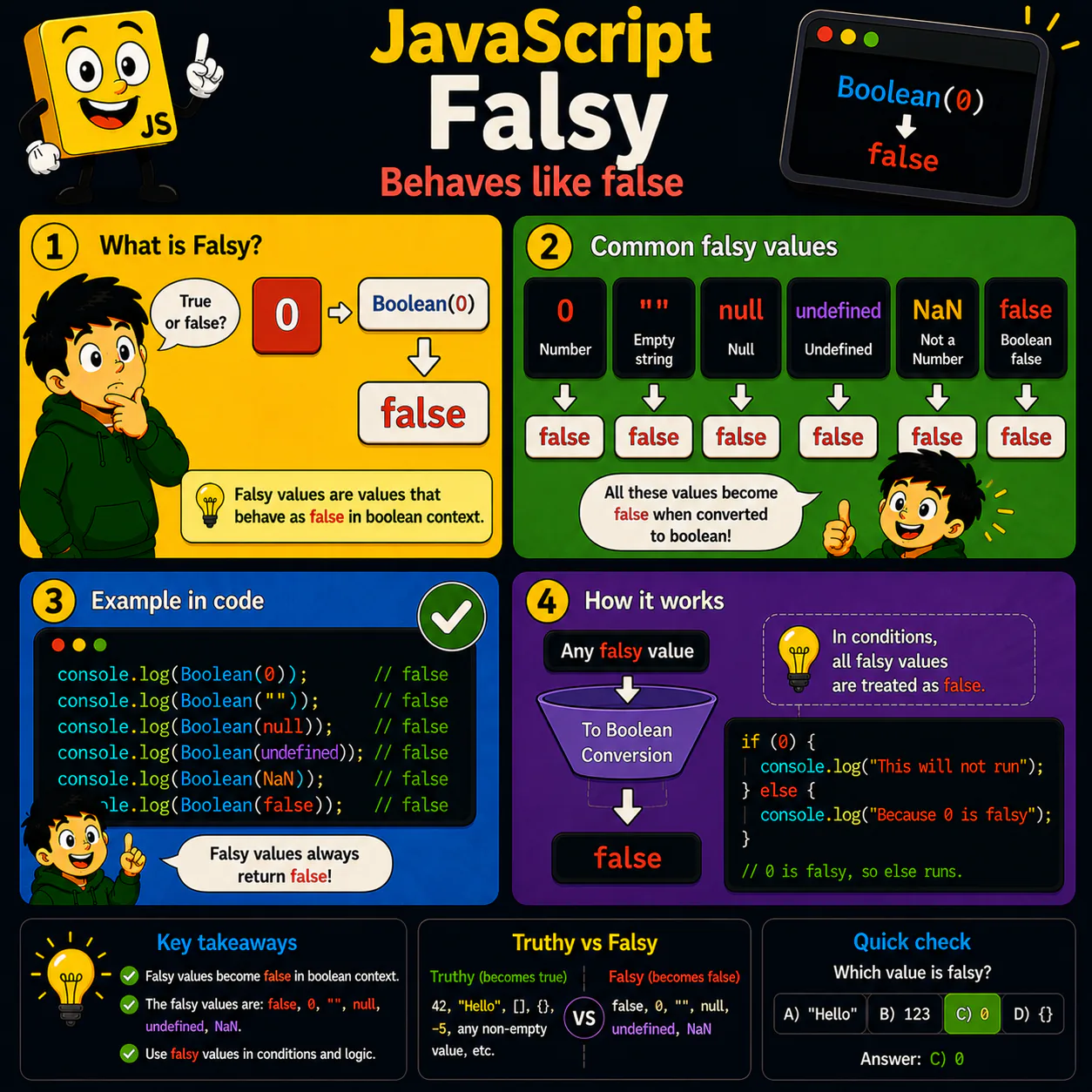
- Falsy values are values that become false when converted to Boolean.
- JavaScript has a small set of falsy values.
- The most common falsy values are false, 0, an empty string, null, undefined, and NaN.
- In if statements, these values behave like false.
- Understanding falsy values helps you write conditions correctly.
Analogy
Imagine a checkpoint. Falsy values do not pass the check and receive false status.
Code
console.log(Boolean(0));
console.log(Boolean(""));
console.log(Boolean(null));
Result: false false false
Common mistake
Beginners often think the string "false" is falsy. In fact, it is a non-empty string, so it is truthy.
Remember
- ✦ Falsy values become false.
- ✦ 0 is falsy.
- ✦ An empty string is falsy.
- ✦ null, undefined, and NaN are also falsy.
Quick Quiz
Which value is falsy?